

Tire Sealant and Compressor Kit
WARNING:
Idling a vehicle in an enclosed area with poor
ventilation is dangerous. Engine exhaust may
enter the vehicle. Engine exhaust contains Carbon
Monoxide (CO) which cannot be seen or smelled.
It can cause unconsciousness and even death.
Never run the engine in an enclosed area that has
no fresh air ventilation. For more information, see
Engine Exhaust.
WARNING:
Over-inflating a tire could cause the tire to rupture
and you or others could be injured. Be sure to
read and follow the tire sealant and compressor kit
instructions and inflate the tire to its recommended
pressure. Do not exceed the recommended
pressure.
WARNING:
Storing the tire sealant and compressor kit or
other equipment in the passenger compartment of
the vehicle could cause injury. In a sudden stop or
collision, loose equipment could strike someone.
Store the tire sealant and compressor kit in its
original location.
If this vehicle has a tire sealant and compressor kit, there may not be a spare tire, tire changing equipment, and on some vehicles there may not be a place to store a tire.
The tire sealant and compressor can be used to temporarily seal punctures up to 1⁄4 inch (6 mm) in the tread area of the tire. It can also be used to inflate an under inflated tire.
If the tire has been separated from the wheel, has damaged sidewalls, or has a large puncture, the tire is too severely damaged for the tire sealant and compressor kit to be effective. See Roadside Assistance Program.
Read and follow all of the tire sealant and compressor kit instructions.
The kit includes:
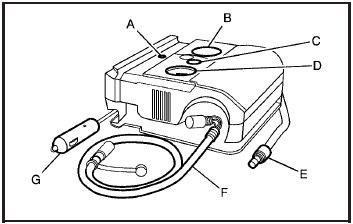
A. On/Off Button
B. Selector Switch (Sealant/Air or Air Only)
C. Pressure Relief Button
D. Pressure Gage
E. Air Only Hose (Black)
F. Sealant/Air Hose (Clear)
G. Power Plug
See also:
Transmission
Automatic Transmission
Driver Shift Control (DSC)
Driver Shift Control (DSC) allows
shifting an automatic transmission
similar to a manual transmission.
DSC can be enabled through the
shift l ...
Ultrasonic Rear Parking
Assist (URPA)
For vehicles with the URPA system, it operates at
speeds less than 8 km/h (5 mph), and assists the driver
with parking and avoiding objects while in R (Reverse).
The sensors on the rear bumper ar ...
Safety Belts
Refer to the following sections for important information on how to use safety
belts properly:
Safety Belts .
How to Wear Safety Belts Properly .
Lap-Shoulder Belt .
Lower Anchors and Te ...