


Steps for Determining Correct Load Limit
1. Locate the statement “The combined weight of occupants and cargo should never exceed XXX kg or XXX lbs” on your vehicle's placard.
2. Determine the combined weight of the driver and passengers that will be riding in your vehicle.
3. Subtract the combined weight of the driver and passengers from XXX kg or XXX lbs.
4. The resulting figure equals the available amount of cargo and luggage load capacity.
For example, if the “XXX” amount equals 1400 lbs and there will be five 150 lb passengers in your vehicle, the amount of available cargo and luggage load capacity is 650 lbs (1400 − 750 (5 x 150) = 650 lbs).
5. Determine the combined weight of luggage and cargo being loaded on the vehicle.
That weight may not safely exceed the available cargo and luggage load capacity calculated in Step 4.
6. If your vehicle will be towing a trailer, the load from your trailer will be transferred to your vehicle. Consult this manual to determine how this reduces the available cargo and luggage load capacity of your vehicle.
This vehicle is neither designed nor intended to tow a trailer.
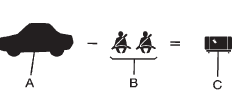 Example 1
A. Vehicle Capacity Weight for Example 1 = 453 kg (1,000 lbs).
B. Subtract Occupant Weight @ 68 kg (150 lbs) × 2 = 136 kg (300 lbs).
C. Available Occupant and Cargo Weight = 317 kg (700 lbs).
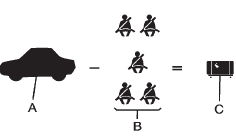 Example 2
A. Vehicle Capacity Weight for Example 2 = 453 kg (1,000 lbs).
B. Subtract Occupant Weight @ 68 kg (150 lbs) × 5 = 340 kg (750 lbs).
C. Available Cargo Weight = 113 kg (250 lbs).
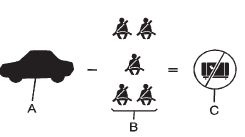 Example 3
A. Vehicle Capacity Weight for Example 3 = 453 kg (1,000 lbs).
B. Subtract Occupant Weight @ 91 kg (200 lbs) × 5 = 453 kg (1,000 lbs).
C. Available Cargo Weight = 0 kg (0 lbs).
Refer to the vehicle's Tire and Loading Information label for specific information about the vehicle's capacity weight and seating positions. The combined weight of the driver, passengers, and cargo should never exceed the vehicle's capacity weight.
See also:
Using this Manual
To quickly locate information about the vehicle, use the Index in the back of
the manual. It is an alphabetical list of what is in the manual and the page number
where it can be found. ...
Electric Parking Brake Light
The parking brake status light comes on when the brake is applied. If the light continues flashing after the parking brake is released, or while driving, there is a problem with the Electric Parking ...
Connections
OnStar Hands-Free Calling allows calls to be made and received from the vehicle.
The vehicle can also be controlled from a cell phone through the OnStar mobile app.
See www.onstar.com for coverage ...