

Freeway Driving
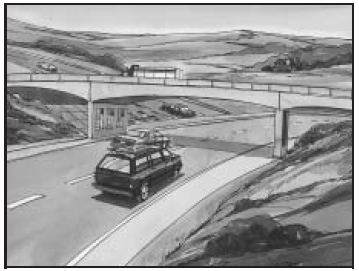
Mile for mile, freeways — also called thruways, parkways, expressways, turnpikes, or superhighways — are the safest of all roads.
But they have their own special rules.
The most important advice on freeway driving is:
Keep up with traffic and keep to the right.
Drive at the same speed most of the other drivers are driving. Too-fast or too-slow driving breaks a smooth traffic flow. Treat the left lane on a freeway as a passing lane.
At the entrance, there is usually a ramp that leads to the freeway. If you have a clear view of the freeway as you drive along the entrance ramp, you should begin to check traffic. Try to determine where you expect to blend with the flow. Try to merge into the gap at close to the prevailing speed.
Switch on your turn signal, check your mirrors, and glance over your shoulder as often as necessary.
Try to blend smoothly with the traffic flow.
Once you are on the freeway, adjust your speed to the posted limit or to the prevailing rate if it is slower. Stay in the right lane unless you want to pass.
Before changing lanes, check your mirrors.
Then use your turn signal.
Just before you leave the lane, glance quickly over your shoulder to make sure there is not another vehicle in your blind spot.
Once you are moving on the freeway, make certain you allow a reasonable following distance.
Expect to move slightly slower at night.
When you want to leave the freeway, move to the proper lane well in advance. If you miss your exit, do not, under any circumstances, stop and back up. Drive on to the next exit.
The exit ramp can be curved, sometimes quite sharply. The exit speed is usually posted.
Reduce your speed according to your speedometer, not to your sense of motion.
After driving for any distance at higher speeds, you may tend to think you are going slower than you actually are.
See also:
Transmission
Automatic Transmission
Driver Shift Control (DSC)
Driver Shift Control (DSC) allows
shifting an automatic transmission
similar to a manual transmission.
DSC can be enabled through the
shift l ...
Lane Departure Warning (LDW)
For vehicles with LDW, it is intended to help avoid lane
change collisions. It provides a warning if the vehicle
is crossing a lane without using a turn signal. LDW uses
a camera to detect the l ...
Emergency
With Automatic Crash Response, the built-in system can automatically connect
to help in a crash even if you cannot ask for it.
Push to connect to an Emergency
Advisor. GPS technology is used to ...