


Lower Anchor and Top Tether AnchorLocations
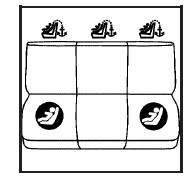
Second Row
 (Top Tether Anchor):
Seating positions with top tether anchors.
 (Lower Anchor):
Seating positions with two lower anchors.
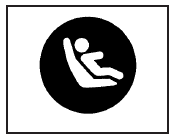
To assist you in locating the lower anchors, each seating position with lower anchors has two labels, near the crease between the seatback and the seat cushion.
The labels are located above a flap, at the base of the seatback, in the rear outside seating positions. The anchors are located under the flap.
In order to get to the anchors you will need to pull the strap at the center of the seat where the seat cushion meets the seatback. This will allow you to fold the seat cushion up and out of the way. Lift the flap to expose the anchors and then lower the seat cushion. Be sure the cushion is locked into place.
The top tether anchors for each rear seating position are located on the floor in the cargo area of your vehicle. Do not use the rear tie-down brackets near the liftgate for top tethers. Be sure to use an anchor located on the same side of the vehicle as the seating position where the child restraint will be placed.
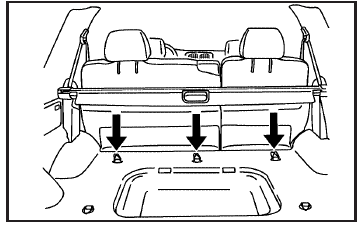
Do not secure a child restraint in the right front passenger’s position, if a national or local law requires that the top tether be attached, or if the instructions that come with the child restraint say that the top tether must be attached. There is no place to attach the top tether in this position.
Accident statistics show that children are safer if they are restrained in the rear rather than the front seat. See Where to Put the Restraint on page 52 for additional information.
See also:
Cruise Control Light
The cruise control light is white whenever the cruise control is set, and turns green when the cruise control is active.
The light turns off when the cruise control is turned off. See Cruise Contro ...
Tire Chains
CAUTION:
Do not use tire chains. There is not
enough clearance. Tire chains used on a
vehicle without the proper amount of
clearance can cause damage to the
brakes, suspension, or other vehicle ...
Control of a Vehicle
You have three systems that make your
vehicle go where you want it to go. They are
the brakes, the steering, and the accelerator.
All three systems have to do their work at
the places where the ...