

Automatic Transmission
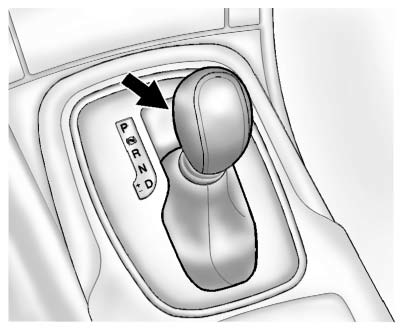
The automatic transmission has a shift lever located on the console between the seats.
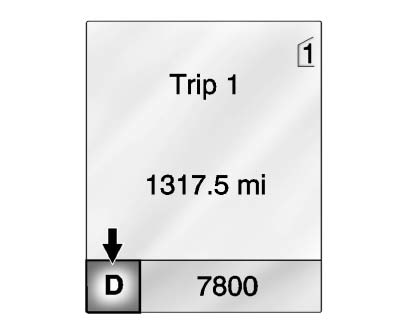
The mode or selected gear is shown in the instrument cluster
P (Park): This position locks the drive wheels. It is the best position to use when starting the engine because the vehicle cannot move easily.
 WARNING
It is dangerous to get out of the vehicle if the shift lever is not fully in P (Park) with the parking brake firmly set. The vehicle can roll.
Do not leave the vehicle when the engine is running unless you have to. If you have left the engine running, the vehicle can move suddenly. You or others could be injured. To be sure the vehicle will not move, even when you are on level ground, always set the parking brake and move the shift lever to P (Park). See Shifting Into Park (Automatic Transmission) .
Make sure the shift lever is fully in P (Park) before starting the engine.
The vehicle has an automatic transmission shift lock control system. The regular brake must be fully applied first and then the shift lever button pressed before shifting from P (Park) when the ignition key is in ON/RUN. If you cannot shift out of P (Park), ease pressure on the shift lever, then push the shift lever all the way into P (Park) as you maintain brake application. Then press the shift lever button and move the shift lever into another gear. See Shifting out of Park (Automatic Transmission) .
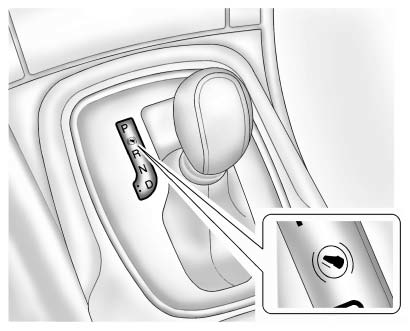
Without the brake pedal applied, the control indicator will be on.
If the shift lever is not in P (Park) when the ignition is turned to OFF, the control indicator and P will flash.
R (Reverse): Use this gear to back up.
Notice: Shifting to R (Reverse) while the vehicle is moving forward could damage the transmission. The repairs would not be covered by the vehicle warranty. Shift to R (Reverse) only after the vehicle is stopped.
To rock the vehicle back and forth to get out of snow, ice, or sand without damaging the transmission, see If the Vehicle Is Stuck .
N (Neutral): In this position, the engine does not connect with the wheels. To restart the engine when the vehicle is already moving, use N (Neutral) only with the brake pedal applied.
The vehicle has an automatic neutral shift feature which allows the transmission to automatically shift to N (Neutral) when the vehicle is stopped with a forward gear engaged and the brake pedal applied. The reduced load on the engine improves vehicle fuel economy.
WARNING
Shifting into a drive gear while the engine is running at high speed is dangerous. Unless your foot is firmly on the brake pedal, the vehicle could move very rapidly.
You could lose control and hit people or objects. Do not shift into a drive gear while the engine is running at high speed.
Notice: Shifting out of P (Park) or N (Neutral) with the engine running at high speed may damage the transmission. The repairs would not be covered by the vehicle warranty. Be sure the engine is not running at high speed when shifting the vehicle
D (Drive): This position is for normal driving. It provides the best fuel economy. If more power is needed for passing, and the vehicle is:
► Going less than 56 km/h (35 mph), push the accelerator pedal about halfway down. ► Going about 56 km/h (35 mph) or more, push the accelerator all the way down.Notice: If the vehicle seems to accelerate slowly or not shift gears when you go faster, and you continue to drive the vehicle that way, you could damage the transmission. Have the vehicle serviced right away.
See also:
COOLANT LEVEL LOW ADD
COOLANT
This message will display if the
coolant is low. See Engine Coolant. ...
Service Parts Identification Label
This label, on the spare tire cover, has the following
information:
• Vehicle Identification Number (VIN)
• Model designation
• Paint information
• Production options and special equipme ...
General Information
For service and parts needs, visit your dealer. You will receive genuine GM parts
and GM-trained and supported service people.
Genuine GM parts have one of these marks:
...