

Cooling System
When you decide it is safe to lift the hood, here is what you will see:
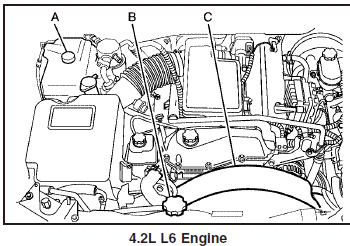
A. Coolant Recovery Tank
B. Radiator Pressure Cap
C. Engine Fan
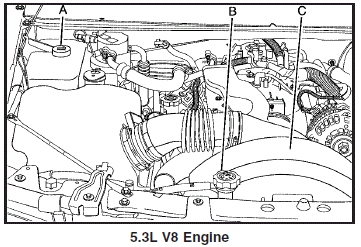
A. Coolant Recovery Tank
B. Radiator Pressure Cap
C. Engine Fan
If the coolant inside the coolant recovery tank is boiling, do not do anything else until it cools down.
The vehicle should be parked on a level surface.
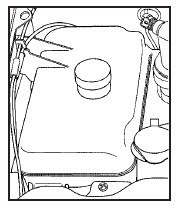
The coolant level should be at least up to the FULL COLD mark. If it is not, you may have a leak at the pressure cap or in the radiator hoses, heater hoses, radiator, water pump, or somewhere else in the cooling system.
CAUTION:
Heater and radiator hoses, and other
engine parts, can be very hot. Do not
touch them. If you do, you can be burned.
Do not run the engine if there is a leak.
If you run the engine, it could lose all coolant. That could cause an engine fire, and you could be burned. Get any leak fixed before you drive the vehicle.
If there seems to be no leak, start the engine again. The engine cooling fan speed should increase when idle speed is doubled by pushing the accelerator pedal down. If it does not, your vehicle needs service. Turn off the engine.
Notice: Engine damage from running your engine without coolant is not covered by your warranty.
Notice: Using coolant other than DEX-COOL® may cause premature engine, heater core, or radiator corrosion. In addition, the engine coolant could require changing sooner, at 30,000 miles (50 000 km) or 24 months, whichever occurs first. Any repairs would not be covered by your warranty. Always use DEX-COOL® (silicate-free) coolant in your vehicle.
See also:
Other Rainy Weather Tips
Besides slowing down, other wet weather driving tips include:
Allow extra following distance.
Pass with caution.
Keep windshield wiping equipment in good shape.
Keep the windshield washer fl ...
Replacement Bulbs
For replacement bulbs not listed
here, contact your dealer. ...
Receiving a Call
When an incoming call is received,
the audio system mutes and a ring
tone is heard in the vehicle.
• Press to answer the call.
• Press to ignore a call. ...