

Emissions Inspection and Maintenance Programs
Some local governments may have programs to inspect the on-vehicle emission control equipment. For the inspection, the emission system test equipment is connected to the vehicle’s Data Link Connector (DLC).
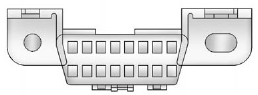
The DLC is under the instrument panel next to the steering wheel. See your dealer if assistance is needed.
The vehicle may not pass inspection if:
- The malfunction indicator lamp is on while the vehicle is running. The vehicle is in ON/RUN for keyed access, or service only mode for keyless access and the malfunction indicator lamp does not come on. See your dealer for assistance in verifying proper operation of the malfunction indicator lamp.
- The OBD II (On-Board Diagnostics) system determines that critical emission control systems have not been completely diagnosed. The vehicle would be considered not ready for inspection. This can happen if the 12-volt battery has recently been replaced or run down. The diagnostic system is designed to evaluate critical emission control systems during normal driving. This can take several days of routine driving. If this has been done and the vehicle still does not pass the inspection for lack of OBD II system readiness, your dealer can prepare the vehicle for inspection.
See also:
Navigation
OnStar navigation requires the
Directions and Connections
service plan.
Push to receive directions or
have them sent to the vehicle
navigation screen. Destinations can
also be forwarded to ...
Introduction
The names, logos, emblems, slogans, vehicle model names, and vehicle body designs appearing in this manual including, but not limited to, GM, the GM logo, BUICK, the BUICK Emblem, and REGAL are trad ...
Recreational Vehicle Towing
Recreational vehicle towing means towing the vehicle behind another vehicle –
such as behind a motor home. The two most common types of recreational vehicle towing
are known as dinghy towing and ...