

Certification/Tire Label
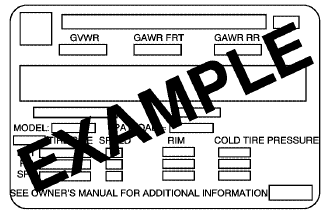
A vehicle specific Certification/Tire label is found on the rear edge of the driver’s door. The label shows the size of your vehicle’s original tires and the inflation pressures needed to obtain the gross weight capacity of your vehicle. This is called Gross Vehicle Weight Rating (GVWR).
The GVWR includes the weight of the vehicle, all occupants, fuel, cargo, and trailer tongue weight, if pulling a trailer.
The Certification/Tire label also tells you the maximum weights for the front and rear axles, called Gross Axle Weight Rating (GAWR). To find out the actual loads on your front and rear axles, you need to go to a weigh station and weigh your vehicle. Your dealer can help you with this. Be sure to spread out your load equally on both sides of the center line.
Never exceed the GVWR for your vehicle, or the GAWR for either the front or rear axle.
And, if you do have a heavy load, you should spread it out.
Similar appearing vehicles may have different GVWRs and capacity weights. Please note your vehicle’s Certification/Tire label or consult your dealer for additional details.
CAUTION:
Do not load your vehicle any heavier than
the Gross Vehicle Weight Rating (GVWR),
or either the maximum front or rear Gross
Axle Weight Rating (GAWR). If you do,
parts on your vehicle can break, and it
can change the way your vehicle handles.
These could cause you to lose control
and crash. Also, overloading can shorten
the life of your vehicle.
Using heavier suspension components to get added durability might not change your vehicle’s weight ratings. Ask your dealer to help you load your vehicle the right way.
Notice: Overloading your vehicle may cause damage. Repairs would not be covered by your warranty. Do not overload your vehicle.
If you put things inside your vehicle — like suitcases, tools, packages, or anything else-they will go as fast as the vehicle goes. If you have to stop or turn quickly, or if there is a crash, they will keep going.
CAUTION:
Things you put inside your vehicle can
strike and injure people in a sudden stop
or turn, or in a crash.
• Put things in the cargo area of your
vehicle. Try to spread the weight
evenly.
• Never stack heavier things, like
suitcases, inside the vehicle so that
some of them are above the tops of
the seats.
• Do not leave an unsecured child
restraint in your vehicle.
• When you carry something inside the
vehicle, secure it whenever you can.
• Do not leave a seat folded down
unless you need to.
There is also important loading information for off-road driving in this manual.
See also:
TPMS Malfunction Light and
Message
The TPMS will not function properly
if one or more of the TPMS sensors
are missing or inoperable. When the
system detects a malfunction, the
low tire warning light flashes for
about one minu ...
DVD Distortion
Video distortion can occur when
operating cellular phones, scanners,
CB radios, Global Position Systems
(GPS)*, two-way radios, mobile fax
machines, or walkie talkies.
It might be necessary t ...
Cruise Control
Your vehicle has cruise
control. The controls are
located on the end of
the turn signal/
multifunction lever.
(On): Move the switch to
this position to turn
the cruise control system on.
...