

Fuel Gauge
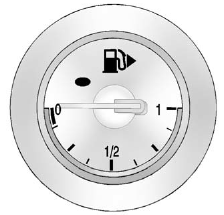
When the ignition is on, the fuel gauge tells you about how much fuel you have left in your tank.
An arrow on the fuel gauge indicates the side of the vehicle the fuel door is on.
When the fuel is low, a message may appear in the Driver Information Center (DIC), and a chime will sound. See Fuel System Messages for more information.
Here are four things that some owners ask about. None of these show a problem with your fuel gauge:
- At the service station, the fuel pump shuts off before the gauge reads full.
- It takes a little more or less fuel to fill up than the gauge indicated. For example, the gauge may have indicated the tank was half full, but it actually took a little more or less than half the tank's capacity to fill the tank.
- The gauge moves a little while turning a corner or speeding up.
- The gauge takes a few seconds to stabilize after the ignition is turned on, and will go back to empty when the ignition is turned off.
See also:
Setting Cruise Control
If the cruise button is on when not in
use, it could get bumped and go into
cruise when not desired. Keep the
cruise control switch off when cruise
is not being used.
1. Press to turn the cr ...
Front Axle
When to Check Lubricant
It is not necessary to regularly check front axle
fluid unless you suspect there is a leak or you hear
an unusual noise. A fluid loss could indicate a
problem. Have it insp ...
Setting the Time
The radio may have a button marked with an
H or HR to represent hours and an M or MN
to represent minutes.
Press and hold the hour button until the correct
hour appears on the display. AM or PM ...