

Traction Control System (TCS)
The vehicle has a Traction Control System (TCS) that limits wheel slip.
The system operates if it senses that one or both of the front wheels are slipping or beginning to lose traction. When this happens, the system reduces engine power and/or applies brake pressure to the slipping wheel(s).
The system may be heard or felt while it is working, but this is normal.
TCS automatically comes on whenever the vehicle is started. To limit wheel slip, especially in slippery road conditions, the system should always be left on. But, TCS can be turned off if needed.
 flashes to indicate that TCS is
active. See Traction Control System
(TCS)/StabiliTrak® Light for more information.
flashes to indicate that TCS is
active. See Traction Control System
(TCS)/StabiliTrak® Light for more information.
If there is a problem detected with TCS, SERVICE TRACTION CONTROL is displayed on the Driver Information Center (DIC).
See Ride Control System Messages. When this message
is displayed and comes on and
stays on, the vehicle is safe to drive
but the system is not operational.
Driving should be adjusted accordingly.
If comes on and stays on, reset
the system.
To reset:
1. Stop the vehicle.
2. Turn the engine off and wait 15 seconds.
3. Start the engine.
If still comes on and stays on, the
vehicle needs service.
Notice:
Do not repeatedly brake
or accelerate heavily when TCS is
off. The vehicle's driveline could
be damaged.
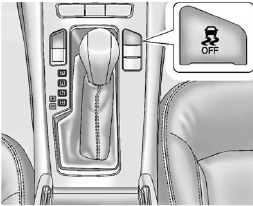
TCS can be turned off by pressing
and releasing the TCS/StabiliTrak
button. When TCS is turned off,  comes on, and the appropriate DIC
message also displays. See Ride
Control System Messages. With TCS turned off, the
system does not limit wheel slip.
comes on, and the appropriate DIC
message also displays. See Ride
Control System Messages. With TCS turned off, the
system does not limit wheel slip.
Driving should be adjusted accordingly. See Traction Off Light for more information.
Press and release the TCS/StabiliTrak button again to turn the system back on.
It may be necessary to turn the system off if the vehicle gets stuck in sand, mud, or snow and rocking the vehicle is required. See If the Vehicle Is Stuck for more information. See also Winter Driving for information on using TCS when driving in snowy or icy conditions.
Adding non-GM accessories can affect the vehicle performance. See Accessories and Modifications for more information.
See also:
Driving Through Deep Standing Water
Notice: If you drive too quickly through
deep puddles or standing water, water can
come in through your engine’s air intake and
badly damage your engine. Never drive through
water that is slight ...
Spare Tire
Your vehicle, when new, had a fully-inflated
spare tire. A spare tire may lose air over time, so
check its inflation pressure regularly.
After installing the spare tire on your vehicle, you
should ...
2012 Buick LaCrosse Review
When I first started reviewing cars five years ago, I can assure you, I never
thought I would find myself eagerly waiting to get behind the wheel of a Buick.
But that started to change when the r ...