

Certification Label
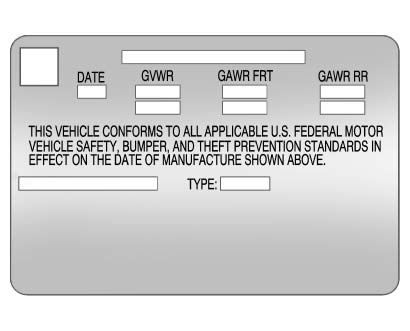 Label Example
A vehicle-specific Certification label is attached to the driver side center pillar (B-pillar).
The label tells the gross weight capacity of the vehicle, called the Gross Vehicle Weight Rating (GVWR). The GVWR includes the weight of the vehicle, all occupants, fuel, and cargo.
Never exceed the GVWR for the vehicle, or the Gross Axle Weight Rating (GAWR) for either the front or rear axle.
And, if there is a heavy load, it should be spread out.
See “Steps for Determining Correct Load Limit” earlier in this section.
 WARNING
Do not load the vehicle any heavier than the Gross Vehicle Weight Rating (GVWR), or either the maximum front or rear Gross Axle Weight Rating (GAWR).
This can cause systems to break and change the way the vehicle handles. This could cause loss of control and a crash. Overloading can also shorten the life of the vehicle.
If you put things inside the vehicle—like suitcases, tools, packages, or anything else—they will go as fast as the vehicle goes. If you have to stop or turn quickly, or if there is a crash, they will keep going.
WARNING
Things inside the vehicle can strike and injure people in a sudden stop or turn, or in a crash.
Try to spread the weight evenly.
Never stack heavier things, like suitcases, inside the vehicle so that some of them are above the tops of the seats.
► Do not leave an unsecured child restraint in the vehicle. ► Secure loose items in the vehicle. ► Do not leave a seat folded down unless needed.See also:
Remote Keyless Entry (RKE)
System
The RKE transmitter is used to remotely lock and
unlock the doors from up to 60 m (195 feet) away from
the vehicle.
Press
to unlock the
driver door. Press again
within five seconds to ...
Braking
Braking action involves perception
time and reaction time. Deciding to
push the brake pedal is perception
time. Actually doing it is
reaction time.
Average driver reaction time is
about thr ...
Passenger Compartment Air Filter
The filter removes dust, pollen, and other airborne irritants from outside air that is pulled into the vehicle.
The filter should be replaced as part of routine scheduled maintenance.
See Scheduled ...