

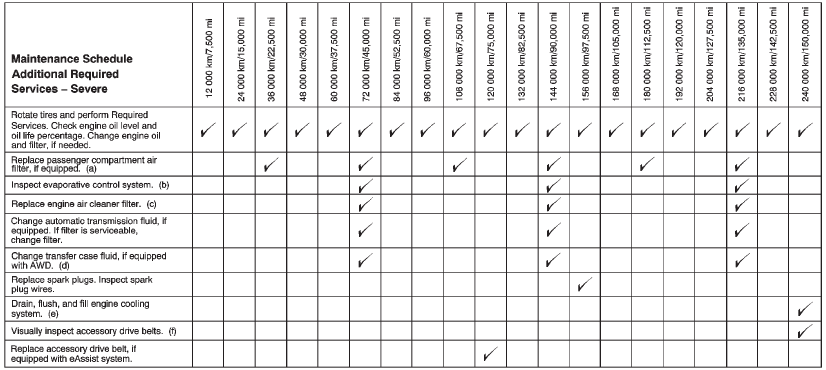
Footnotes — Maintenance Schedule Additional Required Services — Normal
a) Or every two years, whichever comes first. More frequent replacement may be needed if the vehicle is driven in areas with heavy traffic, areas with poor air quality, or areas with high dust levels.
Replacement may also be needed if there is a reduction in air flow, excessive window fogging, or odors.
b) Check all fuel and vapor lines and hoses for proper hook-up, routing, and condition. Check that the purge valve, if the vehicle has one, works properly. Replace as needed.
c) Or every four years, whichever comes first.
d) Do not directly power wash the transfer case output seals. High pressure water can overcome the seals and contaminate the transfer case fluid. Contaminated fluid will decrease the life of the transfer case and should be replaced.
e) Or every five years, whichever comes first. See Cooling System.
f) Or every 10 years, whichever comes first. Inspect for fraying, excessive cracking, or damage; replace, if needed.
See also:
Parking Brake
The vehicle has an Electric Parking Brake (EPB). The switch for the EPB is in
the center console. The EPB can always be activated, even if the ignition is off.
To avoid draining the battery, do ...
Headlamp Aiming
The headlamp aiming system has
been preset at the factory.
If the vehicle is damaged in an
accident, the aim of the headlamps
may be affected and adjustment
may be necessary.
It is recommend ...
StabiliTrak® OFF Light
This light comes on when the StabiliTraK system is turned off.
If the Traction Control System (TCS) is off, wheel spin is not limited.
If StabiliTrak is off, the system does not assist in controll ...