

Rear Seat Passengers
It is very important for rear seat passengers to buckle up! Accident statistics show that unbelted people in the rear seat are hurt more often in crashes than those who are wearing safety belts.
Rear passengers who are not safety belted can be thrown out of the vehicle in a crash.
And they can strike others in the vehicle who are wearing safety belts.
Lap-Shoulder Belt
All rear seat positions have lap-shoulder belts.
Here is how to wear one properly.
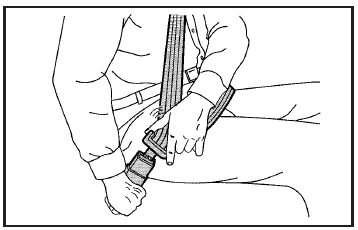
1. Pick up the latch plate and pull the belt across you. Do not let it get twisted.
The shoulder belt may lock if you pull the belt across you very quickly. If this happens, let the belt go back slightly to unlock it. Then pull the belt across you more slowly.
2. Push the latch plate into the buckle until it clicks.
Pull up on the latch plate to make sure it is secure.
When the shoulder belt is pulled out all the way, it will lock. If it does, let it go back all the way and start again.
If the belt is not long enough, see Safety Belt Extender on page 39.
Make sure the release button on the buckle is positioned so you would be able to unbuckle the safety belt quickly if you ever had to.
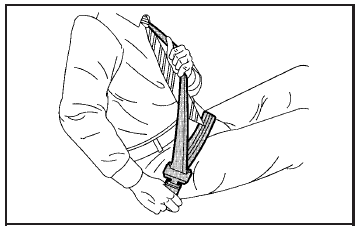
3. To make the lap part tight, pull up on the shoulder part.
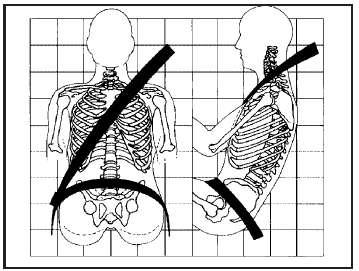
The lap part of the belt should be worn low and snug on the hips, just touching the thighs. In a crash, this applies force to the strong pelvic bones. And you would be less likely to slide under the lap belt. If you slid under it, the belt would apply force at your abdomen. This could cause serious or even fatal injuries. The shoulder belt should go over the shoulder and across the chest. These parts of the body are best able to take belt restraining forces.
The safety belt locks if there is a sudden stop or a crash, or if you pull the belt very quickly out of the retractor.
CAUTION:
You can be seriously hurt if your shoulder
belt is too loose. In a crash, you would
move forward too much, which could
increase injury. The shoulder belt should
fit against your body.
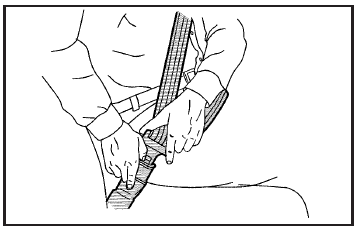
To unlatch the belt, push the button on the buckle.
See also:
Climate Controls
The heating, cooling, and ventilation for the vehicle can be controlled with
these systems.
Automatic Climate Control System
A. Power
B. Temperature Control
C. Fan Control
D. Air Delivery Mod ...
Checking Engine Oil
It is a good idea to check the engine oil level at each
fuel fill. In order to get an accurate reading, the oil must
be warm and the vehicle must be on level ground.
The engine oil dipstick handl ...
Guidelines
The RVC system has a guideline
overlay that can help the driver align
the vehicle when backing into a
parking spot.
To turn the guidelines on or off:
1. Shift into P (Park).
2. Press the CONF ...